Spatial eco-socio-economic trade-offs inform differentiated management strategies in mega-urban agglomerations


Citation
@article{xu2025spatial,
  title={Spatial eco-socio-economic trade-offs inform differentiated management strategies in mega-urban agglomerations},
  author={Xu, Yuhan and Chen, Chen and Deng, Weipeng and Dai, Linlin and Yang, Tianren},
  journal={npj Urban Sustainability},
  volume={5},
  number={1},
  pages={43},
  year={2025},
  publisher={Nature Publishing Group UK London}
}
Abstract
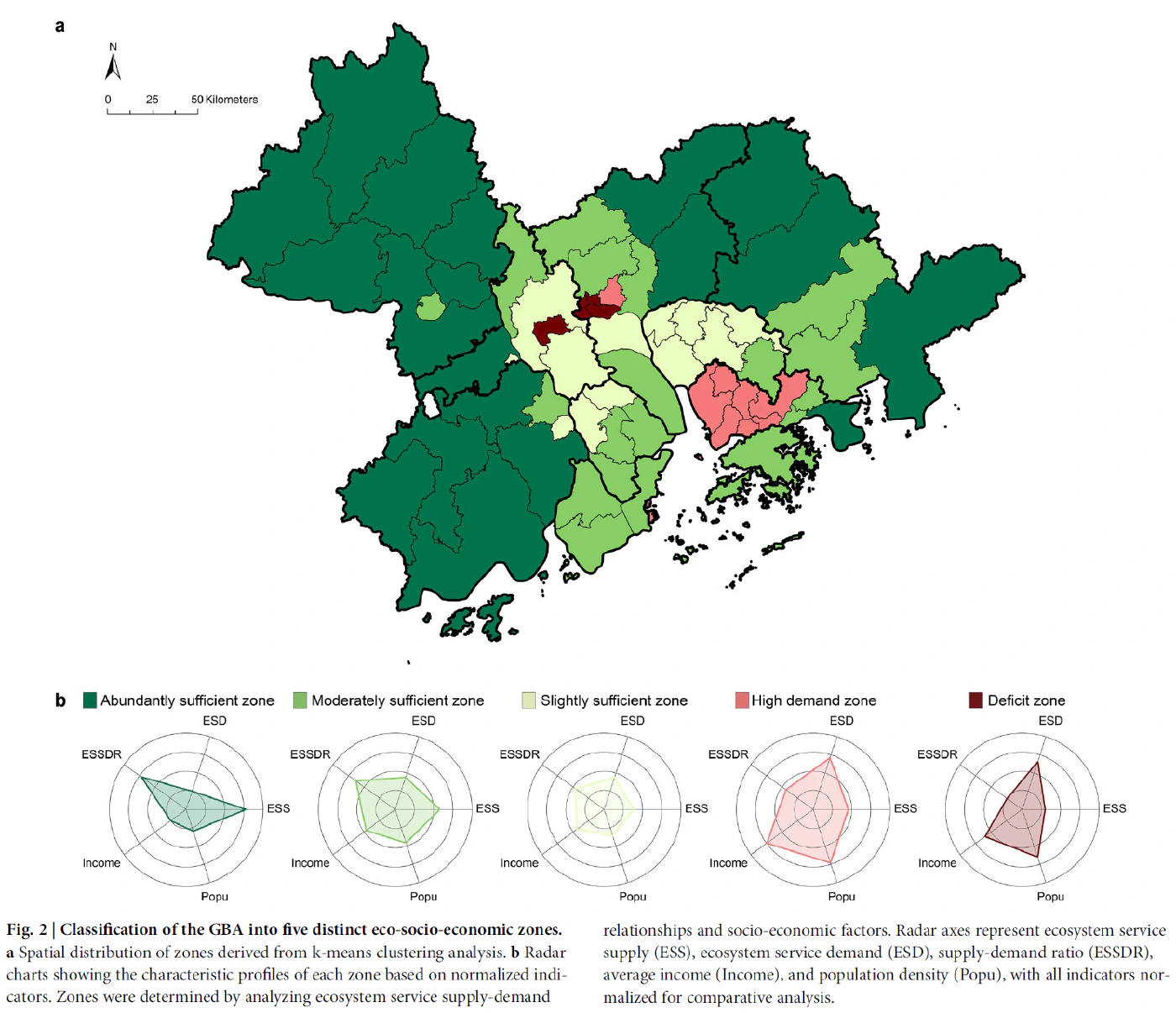
Balancing ecological sustainability with socio-economic development presents a significant challenge for mega-urban regions. Here we introduce a spatial analysis framework that combines clustering techniques with production possibility frontier methodology to quantify and visualize the trade-offs between ecosystem service value and socio-economic well-being . Applying this to the Guangdong-Hong Kong-Macao Greater Bay Area, we identified five distinct eco-socio-economic zones, each requiring different management approaches. Our analysis revealed that economically developed coastal areas exhibit high production efficiency but limited ecological capacity, while less-developed peripheral areas demonstrate significant untapped potential for ecosystem services enhancement. Based on these insights, we formulated tailored strategies for sustainable urban management , including targeted ecological compensation mechanisms between beneficiary and provider regions. This integrated approach provides environmental planners and urban policymakers with a practical toolkit for optimizing sustainability outcomes in complex urban agglomerations, balancing regional economic aspirations with ecological imperatives.
Links: